
How the 1973 Quarter Moves from Pocket Change to Price Chart
Most are pocket change.
A few are calculated risks.
Condition is everything.
1973 stands as a year of industrial transition for the United States Mint.
The production cycle functioned under immense pressure, preparing for the upcoming Bicentennial retooling.
As a result, the 1973 quarter became a statistical anomaly where a massive supply hides a near-total absence of quality.
Future 1973 quarter value growth depends on the continued integrity of population reports.

The Physics of Production Failure
Mechanical realities of the early 1970s dictated the current scarcity of high-grade specimens.
High-speed presses operated at maximum capacity, prioritizing quantity over surface integrity.
Planchet feeding systems often caused microscopic abrasions before the striking process even began.
The cupro-nickel cladding, being harder than silver, required higher striking pressure.
This increased pressure accelerated die erosion, resulting in the "mushy" details found on late-year strikes.
Component | Metric |
Core | 100% Copper |
Cladding | 75% Copper, 25% Nickel |
Striking Pressure | Approximately 35-40 tons |
Edge Reeds | 119 Units |
Statistical Impossibility: The MS68 Barrier
The rarity of a 1973 quarter in MS68 condition is not a matter of luck but of logistics.
Minting facilities utilized heavy canvas bags for internal transport.
Coins falling from the press into these bags struck one another, creating "bag marks" on Washington's cheek.
Finding a specimen that escaped this process is a 1-in-500-million event.
Mint Mark | Total Mintage | MS67 Population | MS68 Population |
Philadelphia (P) | 346,924,000 | 48 | 0 |
Denver (D) | 232,977,400 | 182 | 1 |
San Francisco (S) | 2,760,339 | 89 (PR70) | 0 |
The data confirms that for Philadelphia strikes, a perfect MS68 grade currently does not exist in the professional registry.
Financial Forensics: Auction Volatility
The market price for 1973 quarters follows a parabolic curve based on technical grading.
A single point on the Sheldon scale can represent a 5,000% increase in realized value.
Price history shows that MS67 specimens act as a ceiling for most serious investors.
Significant Auction Closures
1973-S PR70 Deep Cameo: Sold for $2,760
1973-D MS68 (The only one): Sold for $1,438
1973-P MS67+: Sold for $1,140
1973-D MS67: Realized $240
Market liquidity for MS65 coins remains stagnant, with prices hovering near $15 for over a decade.
Investment growth is concentrated exclusively in the top 0.01% of the population report.
The Bicentennial Shadow
The looming 1976 anniversary dictated the 1973 production schedule.
Mint engineers focused on testing new dual-date hubs, neglecting the maintenance of 1973 dies.
This technical neglect produced a high volume of "die state" varieties.
Collectors looking for "Proof-like" surfaces on circulation strikes find almost none from this year.
The absence of a 1975-dated quarter forced the 1973 dies to stay in service longer than intended.
Extended die usage resulted in "orange peel" textures on the coin fields.
Planchet Errors
Errors from 1973 serve as a hedge against the volatility of high-grade coins.
An error's value is derived from the failure of the automated inspection systems of that era.
Documented Industrial Errors
Wrong Planchet Strikes: Quarters struck on 10-cent blanks weigh exactly 2.27 grams.
Partial Cladding: The failure of the bonding process leaves one side appearing as raw copper.
Capped Die: A coin remains stuck on the die, striking subsequent planchets and creating a blurred, concave image.
Broadstrikes: Coins struck outside the retaining collar, resulting in a flat, oversized appearance.
A 1973 quarter struck on a dime planchet can realize between $400 and $600 at major auctions.
Broadstruck errors in uncirculated condition maintain a steady value of $150.
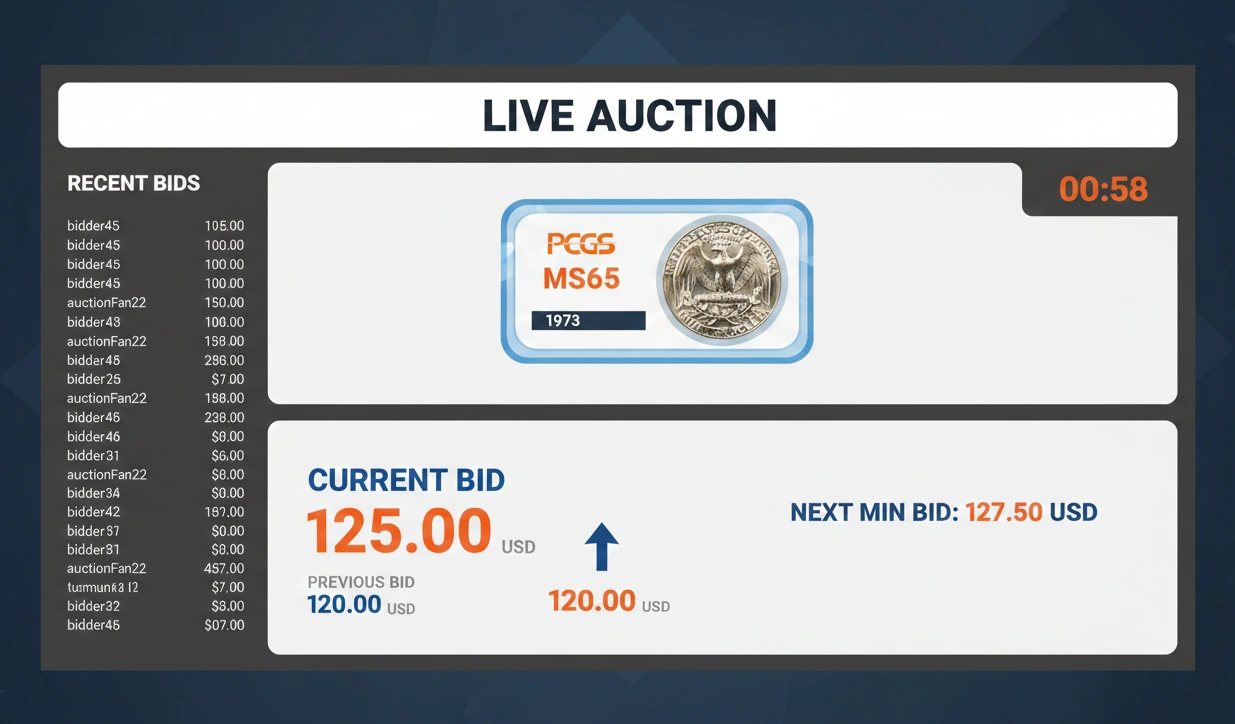
Grading Logistics: The Cost of Certification
Submitting a 1973 quarter for grading involves a specific financial calculation.
The probability of receiving an MS67 grade must be balanced against the fixed costs of the service.
Estimated Cost Basis for Grading
Certification Fee: $25 - $50
Shipping and Handling: $15
Insurance Premiums: $10
Auction House Commission: 15% - 20%
If a coin returns as MS65, the investor incurs a net loss of approximately $45.
Break-even occurs only at the MS66+ level, assuming a successful sale at market peak.
Longevity and Degradation Factors
Chemical stability of the 1973 alloy is generally high, yet environmental factors persist.
Improper storage in high-humidity areas leads to "milk spots" on Proof surfaces.
Circulated coins lose their technical detail through constant friction, moving from "Fine" to "Good" grades within 24 months of heavy use.
Factors Accelerating Value Loss
PVC damage from old plastic holders
Carbon spots caused by improper handling without gloves
Micro-scratches from "cleaning" with soft cloths
Rim dings from contact with harder surfaces
The 1973 quarter is not a rarity of design, but a rarity of industrial perfection.
Over 580 million pieces were produced, yet less than 300 have achieved an investment-grade status.
Market interest remains tied to the statistical difficulty of finding "Gem" condition coins.
As more original bags are opened, the discovery of a new MS68 could dilute the current market by 30%.
Precision grading remains the only barrier between a 25-cent coin and a four-figure asset.